Venice Forum Asks What Democratizing Cinema Really Takes: Tools Are Not a Seat at the Table
At the 83rd Venice Film Festival, an ANFFF public forum found the tools have got cheaper but the barriers to filmmaking
Press Release Disclaimer: This is a press release distributed through the XPR Media network. It has not been independently verified by our newsroom.
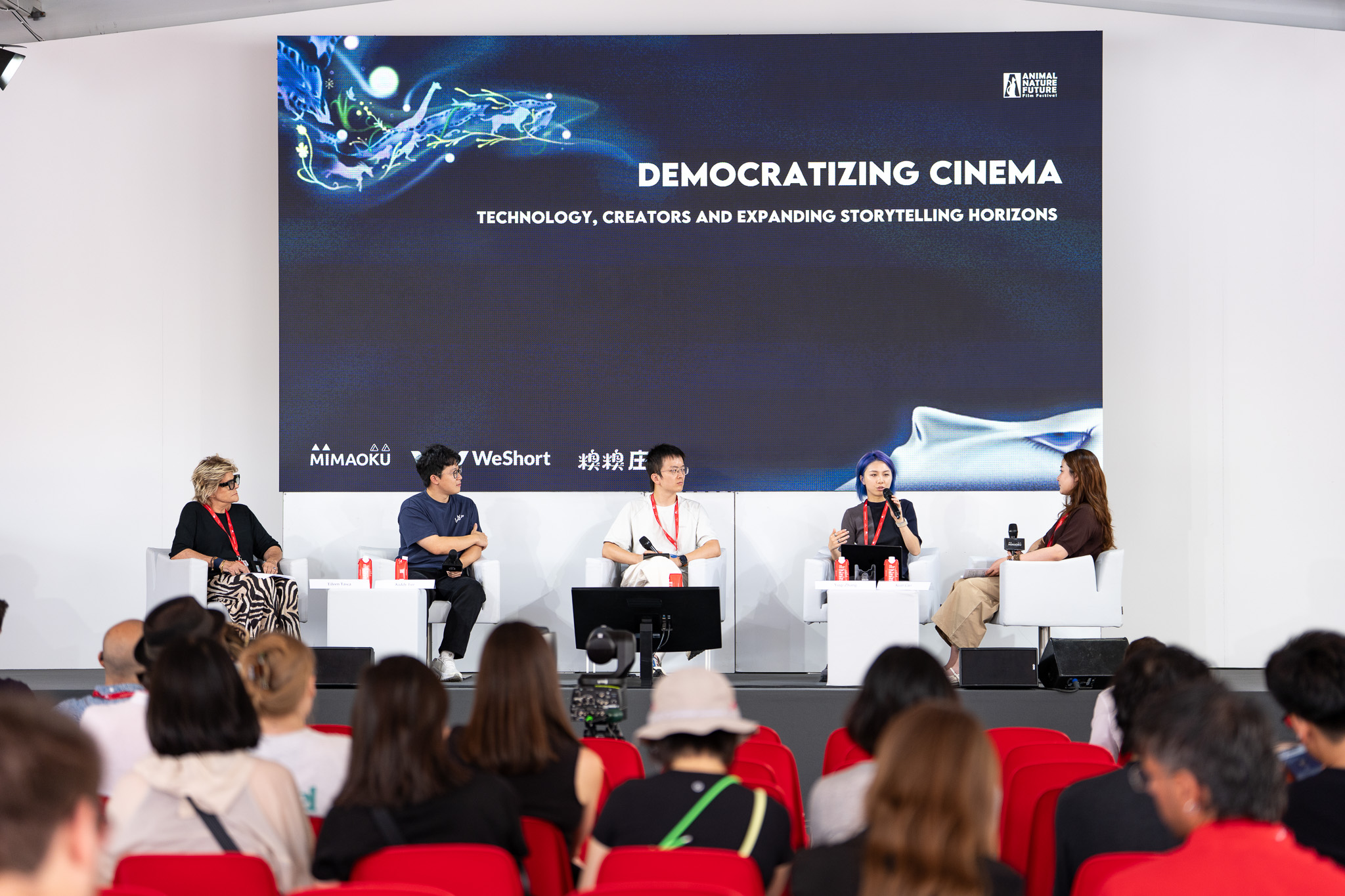

At the 83rd Venice Film Festival, an ANFFF public forum found the tools have got cheaper but the barriers to filmmaking have moved, not disappeared.
VENICE, VENICE, ITALY, September 9, 2026 /EINPresswire.com/ — During the 83rd Venice International Film Festival, the public forum “Democratizing Cinema: Technology, Creators and Expanding Storytelling Horizons” was held at the Biennale Match Point Arena as part of the official Venice Production Bridge programme. The forum was presented by the Animal · Nature · Future Film Festival (ANFFF) Creator Incubator, the flagship non-profit programme of International Nature Bond CIC, in collaboration with MIMAOKU and WeShort, and moderated by Kean Cao, CEO of MIMAOKU and founder of ANFFF.
The forum brought together four creators with markedly different relationships to technology: Eileen Tasca, Italian producer of EO (Cannes Jury Prize; 2023 Academy Award nominee for Best International Feature Film); Shixin Tao and Yuqi Zhang, co-directors of The Pigeon Ring, a 4D Gaussian Splatting immersive work produced by Media Storm and selected for the Official Competition of Venice Immersive; and Kiddy Lee, chief director of A Cat Named T-Rex, an ANFFF-supported short combining real footage with AI-generated animation. The three works represent, respectively, a hand-built immersive reconstruction, a hybrid of real footage and AI animation, and a purely live-action feature “without a single generated pixel”.
The moderator opened with the question that ran through the session: does easier image-making mean easier filmmaking, or does the barrier simply move somewhere else? The three young creators answered in strikingly similar terms. The tools have become cheaper; what actually held them back was the team, the money and the pitch. Zhang said that for a new creator wanting to work with a frontier technology such as Gaussian Splatting, “either you collaborate with a university, or you spend a lot of money to work with a mature technical team — those were really our only two choices.” Tao said the hardest part of The Pigeon Ring was not the technology but “describing something that did not exist yet, with enough conviction that everyone could believe in it.” Lee added that AI saves budget and crew, “but it doesn’t save effort.”
The Pigeon Ring team illustrated how a new technology can demand more traditional craft, not less. Some 300 cameras surrounded rehearsed live performances, reconstructed with 4D Gaussian Splatting into a real Chinese family home that audiences walk through. Choosing the technology, Zhang said, “changed our whole pipeline — it’s closer to theatre than to film: there are no cutting points, we cover transitions with continuous performance, and most of it is long takes of two or three minutes.” With almost no precedent to reference, Tao said, “we had to build the pipeline from scratch.” Looking ahead, he expects AI to reduce the requirement: “Today we need 300 cameras. In the future, maybe 20 or 12 cameras will do.”
Tasca pushed the question to the institutional level. Asked what opportunities AI offers traditional filmmakers, she gave the session’s sharpest answer: “Technology does not compensate for institutions, for rights, for laws. If things aren’t codified in laws, then it becomes personal — what kind of clout do you have, what kind of family do you come from.” She cited EO: the film grossed more than $1 million in the United States, yet its producers collectively received around $30,000. “We took all the risks, and that has to change.”
On what technology cannot do, Tasca drew the distinction between an image and an experience: “A digital image of EO does not have agency. Our donkeys had agency. We watched them react. That’s the difference.” She also set out the difference between two ways of telling stories: “The immersive creates an emotional architecture, whereas we create emotion in sequences.” Her advice to young creators was to learn the traditional skills first, “then apply these tools and really run with it — I think that’s the future.”
Closing the forum, Tasca redefined democratization as “everybody having the right to be heard — isn’t that the basis of democracy?” Cao concluded that democratization “depends on much more than the availability of tools: on who controls the funding, who has access to expertise and infrastructure, who remains protected, and which audiences are able to encounter the work.”
The forum also announced that submissions for ANFFF 2027 are open on FilmFreeway, and that recruitment has begun for the festival’s first-round international jury. ANFFF receives entries from around 70 countries and territories each year and works with more than 50 charities worldwide.
About ANFFF: The Animal · Nature · Future Film Festival is the flagship non-profit film and cultural programme of International Nature Bond CIC, a UK Community Interest Company, exploring the relationship between animals, nature and the future through film, art and international cultural exchange.
About MIMAOKU: MIMAOKU Culture & Media Ltd is a China–UK cultural and media company with offices in Shanghai and the United Kingdom, working across international co-production, festival PR and cultural events.
Kean Cao
MIMAOKU CULTURE & MEDIA LTD
+44 7421 240607
email us here
Visit us on social media:
LinkedIn
Instagram
Facebook
YouTube
TikTok
X
Other
Legal Disclaimer:
EIN Presswire provides this news content “as is” without warranty of any kind. We do not accept any responsibility or liability
for the accuracy, content, images, videos, licenses, completeness, legality, or reliability of the information contained in this
article. If you have any complaints or copyright issues related to this article, kindly contact the author above.

Media gallery